
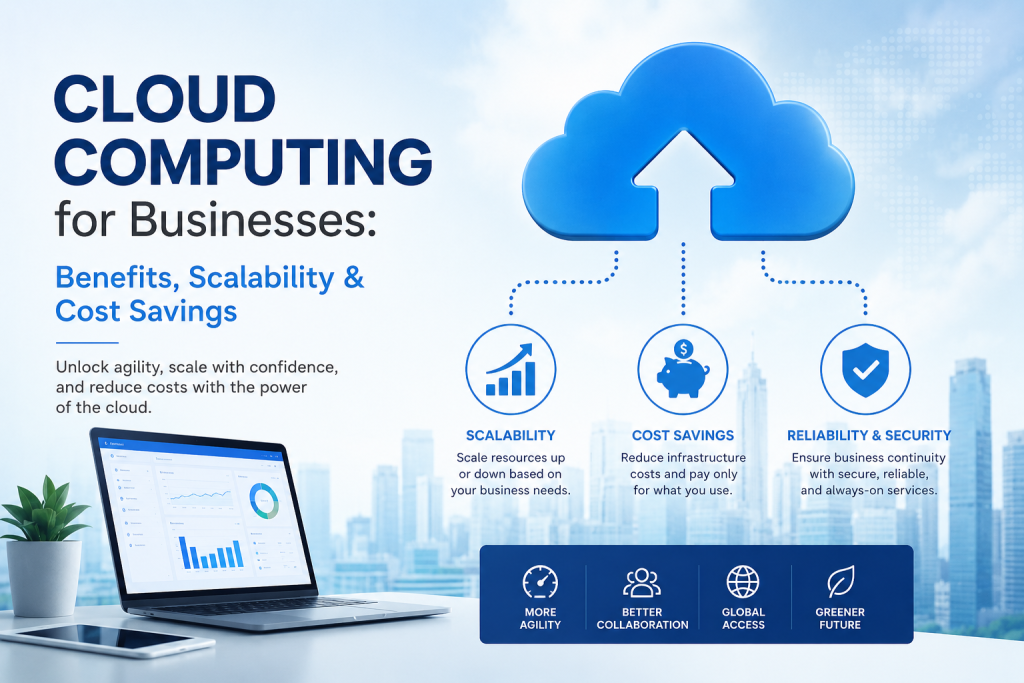
In today’s digital-first world, businesses are constantly searching for smarter ways to improve efficiency, reduce operational costs, and scale faster. Traditional IT infrastructure often requires heavy investments in servers, maintenance, security, and upgrades. This is where cloud computing becomes a game-changer.
Cloud computing enables businesses to access computing resources such as servers, storage, databases, networking, and software over the internet instead of relying on physical infrastructure. From startups to enterprises, companies are rapidly adopting cloud technologies to improve flexibility, security, and performance.
What is Cloud Computing?
Cloud computing is the delivery of IT services through the internet on a pay-as-you-use model. Businesses can host applications, store data, run software, and manage operations without investing heavily in on-premise hardware.
Popular cloud platforms like AWS and Microsoft Azure allow businesses to deploy applications globally, scale instantly, and manage workloads efficiently.
Key Benefits of Cloud Computing for Businesses
1. Significant Cost Savings
One of the biggest advantages of cloud computing is reduced infrastructure cost. Businesses no longer need to purchase expensive servers, maintain data centers, or hire large IT teams for maintenance.
With cloud solutions:
- You pay only for the resources you use
- No upfront hardware investment
- Reduced maintenance and operational costs
- Lower energy and infrastructure expenses
Cloud hosting solutions also help companies optimize resource allocation through auto-scaling and usage monitoring.
Example:
A startup can launch its application on the cloud without spending lakhs on physical servers. As traffic grows, resources can automatically scale without downtime.
2. Scalability & Flexibility
Modern businesses need systems that can grow with demand. Cloud computing offers instant scalability, allowing businesses to increase or decrease resources based on workload.
Whether it’s:
- Seasonal website traffic
- E-commerce sales spikes
- Expanding business operations
- Growing customer databases
Cloud infrastructure adapts in real time.
This flexibility allows businesses to:
- Launch faster
- Expand globally
- Support remote teams
- Handle sudden traffic surges effortlessly
3. Enhanced Security & Data Protection
Data security is a top concern for every business. Cloud providers offer advanced security features including:
- Data encryption
- Multi-factor authentication
- Automated backups
- Disaster recovery
- Compliance management
Cloud environments are designed to protect business data from cyber threats, accidental loss, and downtime.
Businesses also benefit from:
- Secure remote access
- Regular security updates
- Centralized data management
4. Improved Business Continuity
Unexpected events such as hardware failure, cyberattacks, or natural disasters can impact business operations. Cloud computing helps businesses maintain continuity with reliable backup and recovery systems.
Features like:
- Automated backups
- Multi-region hosting
- High availability infrastructure
- Real-time monitoring
ensure that businesses can continue operations with minimal disruption.
5. Faster Deployment & Increased Productivity
Cloud platforms allow businesses to deploy applications and services quickly. Development teams can collaborate efficiently using DevOps and CI/CD pipelines.
Benefits include:
- Faster software deployment
- Reduced development cycles
- Improved team collaboration
- Automated testing and updates
This helps businesses bring products to market faster and stay ahead of competitors.
Types of Cloud Computing Services
Infrastructure as a Service (IaaS)
Provides virtual servers, networking, and storage resources.
Platform as a Service (PaaS)
Offers development environments for building and deploying applications.
Software as a Service (SaaS)
Allows users to access software applications through the internet.
Businesses can choose the right model based on their operational needs and budget.
Why Businesses Are Moving to the Cloud
Companies across industries are adopting cloud solutions because they offer:
- Better operational efficiency
- Lower IT costs
- Greater scalability
- Stronger security
- Remote accessibility
- Faster innovation
Cloud technology also supports modern business trends like:
- Remote work
- AI integration
- Big data analytics
- Mobile applications
- Digital transformation
According to industry trends, businesses using cloud technologies often experience better operational performance and faster growth opportunities.
How VM3 Tech Solutions LLP Helps Businesses with Cloud Computing
VM3 Tech Solutions LLP provides end-to-end cloud solutions designed to help businesses streamline operations, improve scalability, and reduce infrastructure costs.
Their cloud services include:
- AWS & Azure cloud solutions
- Cloud hosting
- Serverless computing
- DevOps & CI/CD implementation
- Cloud migration
- Infrastructure optimization
- Monitoring & support
VM3 Tech Solutions LLP focuses on building secure, scalable, and cost-effective cloud environments tailored to business needs.
Conclusion
Cloud computing is no longer an option — it has become a necessity for businesses looking to stay competitive in the digital era. From reducing costs and improving scalability to enhancing security and accelerating growth, cloud technology empowers businesses to operate smarter and more efficiently.
Whether you are a startup, SME, or enterprise, adopting cloud computing can help future-proof your business and unlock new growth opportunities.
If your business is planning to modernize its infrastructure, improve operational efficiency, or scale digitally, cloud solutions can be the foundation for long-term success.