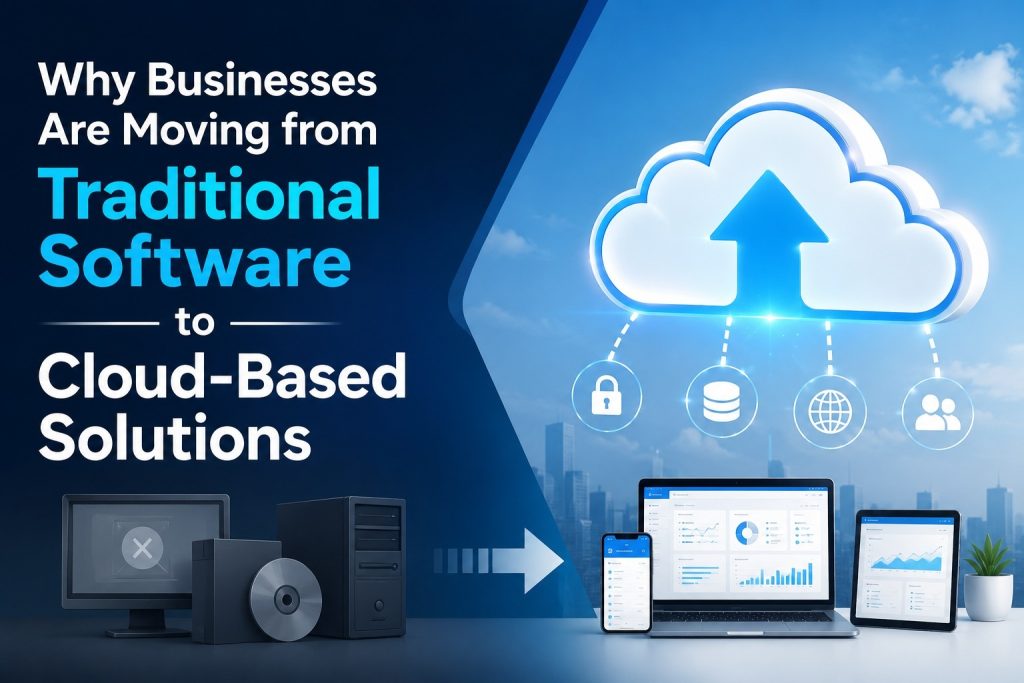
The way businesses use technology is changing rapidly. Traditional software systems that once supported day-to-day operations are increasingly being replaced or upgraded with cloud-based solutions that offer greater flexibility, scalability, accessibility, security, and operational efficiency.
For growing businesses, relying entirely on locally installed software, physical servers, and on-premise infrastructure can create challenges such as high maintenance costs, limited accessibility, hardware dependency, difficult upgrades, and scalability issues.
Cloud technology offers a more flexible approach. Businesses can access applications, data, infrastructure, and computing resources over the internet without depending entirely on physical infrastructure at their office or facility.
But why are so many businesses making the shift from traditional software to cloud-based solutions?
What Is Traditional Software?
Traditional software typically refers to applications and systems installed directly on company computers, servers, or on-premise infrastructure.
Businesses using traditional software may need to manage:
- Physical servers and IT infrastructure
- Software installation and updates
- Hardware maintenance
- Data backups
- Security configurations
- Internal IT support
- Infrastructure upgrades
- Storage and computing capacity
While traditional systems can still be suitable for certain businesses and specific use cases, they can become difficult to maintain as an organization grows.
What Are Cloud-Based Solutions?
Cloud-based solutions are software applications, platforms, storage, and computing resources hosted on cloud infrastructure and accessed through the internet.
Instead of depending entirely on physical infrastructure, businesses can use cloud platforms to run applications, store data, manage workloads, and scale computing resources according to their requirements.
Cloud environments can include services such as:
- Cloud hosting
- Cloud storage
- Virtual machines
- Serverless computing
- Cloud databases
- Business applications
- Backup and disaster recovery
- DevOps and CI/CD environments
Modern cloud infrastructure can also be designed around platforms such as AWS and Microsoft Azure, depending on the organization’s technical and business requirements.
Traditional Software vs Cloud-Based Solutions
The biggest difference is how infrastructure, applications, data, and resources are managed.
| Traditional Software | Cloud-Based Solutions |
|---|---|
| Often depends on local infrastructure | Runs on cloud infrastructure |
| Hardware investment may be required | Infrastructure can scale based on requirements |
| Updates may require manual intervention | Updates and deployments can be streamlined |
| Access may be limited to specific systems or networks | Applications can support remote and distributed access |
| Scaling may require additional hardware | Resources can be scaled more flexibly |
| Maintenance can require significant IT effort | Cloud environments can be centrally managed and monitored |
| Backup infrastructure may need to be maintained separately | Cloud-based backup and recovery options are available |
The right approach depends on the organization’s applications, data, compliance requirements, budget, and long-term technology strategy.
7 Reasons Businesses Are Moving to Cloud-Based Solutions
1. Lower Infrastructure and Operational Costs
Traditional IT environments can require significant investment in servers, networking equipment, storage, maintenance, upgrades, cooling, and technical support.
Cloud computing provides access to infrastructure without requiring businesses to build and maintain the same level of physical infrastructure themselves.
With scalable cloud models, organizations can align computing resources more closely with actual requirements and avoid unnecessary infrastructure capacity.
This can make cloud adoption particularly attractive to startups, SMEs, and growing businesses looking to optimize technology spending.
2. Greater Scalability
Business requirements rarely remain constant.
A website may experience a sudden traffic increase. An application may gain thousands of users. A business may expand into new markets. Internal teams may require additional computing resources.
With traditional infrastructure, scaling may require purchasing and configuring additional hardware.
Cloud environments can provide more flexible resource allocation, allowing businesses to increase or reduce resources according to workload requirements.
This makes cloud technology especially useful for businesses planning rapid growth.
3. Remote and Flexible Access
Modern businesses increasingly operate across multiple locations, offices, and remote teams.
Cloud-based applications allow authorized users to access business systems and data through supported devices and secure connections, helping teams collaborate beyond a single physical location.
This flexibility can improve productivity while supporting modern hybrid and distributed working environments.
4. Improved Business Continuity and Data Protection
Data is one of the most valuable assets of any organization.
Hardware failure, accidental deletion, system crashes, or other disruptions can affect business operations if data protection is inadequate.
Cloud environments can support backup, redundancy, monitoring, and disaster recovery strategies designed around business requirements.
A well-planned cloud architecture can therefore help businesses improve resilience and reduce dependency on a single physical infrastructure environment.
5. Faster Deployment and Updates
Traditional software environments can make application deployment and updates time-consuming.
Modern cloud infrastructure combined with DevOps and CI/CD practices can streamline development, testing, deployment, and monitoring.
This enables development teams to deliver updates more efficiently while reducing manual deployment processes.
For businesses operating in competitive markets, faster deployment can translate into faster response to customer and market requirements.
6. Better Security and Monitoring
Security is one of the most important considerations when moving business systems to the cloud.
Leading cloud platforms provide a wide range of security, identity management, monitoring, backup, and infrastructure controls.
However, simply moving to the cloud does not automatically make a system secure.
Businesses need a properly designed architecture, access controls, monitoring, backup strategy, application security, and ongoing management.
A professional cloud implementation can help organizations build security into their infrastructure from the beginning.
7. Easy Integration and Digital Transformation
Businesses rarely use a single software system.
They may have CRM platforms, ERP systems, accounting software, websites, mobile applications, databases, analytics tools, communication platforms, and other business applications.
Cloud infrastructure can make it easier to connect and integrate different systems through APIs, databases, automation tools, and modern application architectures.
This creates a foundation for broader digital transformation and business automation.
When Should a Business Consider Moving to the Cloud?
Cloud migration can be particularly valuable when a business is experiencing one or more of the following challenges:
- Existing servers are becoming outdated
- IT infrastructure requires frequent maintenance
- Business applications are difficult to scale
- Employees need secure remote access
- Infrastructure costs are increasing
- Software deployment is slow
- Data backup and disaster recovery need improvement
- The company is expanding into new locations
- Application traffic is growing rapidly
- The business is developing a new digital product
- Existing software needs modernization
- IT teams spend too much time managing infrastructure
If several of these challenges sound familiar, it may be time to evaluate whether a cloud-based architecture is suitable for your business.
Cloud Migration Does Not Mean Moving Everything at Once
One common misconception is that cloud migration requires a business to immediately move every application, database, and workload to the cloud.
In reality, migration can be planned according to business priorities.
A company may choose to:
- Move selected applications first
- Migrate databases and storage gradually
- Modernize outdated applications
- Use virtual machines for existing workloads
- Adopt serverless architecture for specific applications
- Build hybrid infrastructure
- Move development and testing environments first
- Gradually retire outdated infrastructure
A phased migration strategy can reduce disruption and allow businesses to evaluate performance, security, costs, and user experience at every stage.
How VM3 Tech Solutions LLP Helps Businesses Adopt Cloud Technology
Moving from traditional software and infrastructure to cloud technology requires more than simply transferring files to a cloud server.
Businesses need the right architecture, migration strategy, security approach, deployment process, monitoring, and ongoing optimization.
VM3 Tech Solutions LLP provides end-to-end cloud solutions designed around business requirements, including cloud infrastructure setup, migration, hosting, DevOps, CI/CD, serverless computing, monitoring, and optimization.
Our approach includes:
Business & Cloud Assessment
We understand your existing infrastructure, applications, workloads, business objectives, and technical requirements before recommending a cloud strategy.
Cloud Infrastructure Design
We design cloud environments based on performance, scalability, security, availability, and cost considerations.
Cloud Migration
Existing applications, databases, and workloads can be migrated to the cloud through a structured process designed to minimize disruption and protect data integrity.
DevOps & CI/CD
We help businesses streamline development and deployment through modern DevOps practices and CI/CD pipelines.
Cloud Hosting
Applications can be deployed on scalable cloud infrastructure, including virtual machines and cloud hosting environments.
Monitoring & Optimization
Cloud environments require ongoing monitoring and optimization. We help businesses improve resource utilization, performance, reliability, and operational efficiency.
VM3 Tech Solutions LLP also offers software development and customized technology solutions, enabling businesses to combine software development, cloud infrastructure, automation, and digital transformation with a single technology partner.
Why Choose a Professional Cloud Technology Partner?
Cloud migration is a strategic business decision. Poorly planned migration can result in unnecessary costs, performance issues, security gaps, or operational disruption.
A professional technology partner can help businesses:
- Evaluate the existing infrastructure
- Identify suitable cloud architecture
- Plan migration in phases
- Improve application performance
- Strengthen security
- Optimize cloud resources
- Implement backup and recovery strategies
- Automate deployment processes
- Monitor infrastructure
- Plan for future scalability
The objective should not simply be to “move to the cloud.”
The objective should be to create a more scalable, secure, efficient, and future-ready technology environment.
The Future Is Cloud-Driven
As businesses become more digital, traditional infrastructure alone may not provide the flexibility required for long-term growth.
Cloud-based solutions give businesses the ability to adapt technology resources to changing requirements while supporting modern applications, remote operations, automation, data-driven decision-making, and digital transformation.
For organizations considering modernization, cloud adoption can be more than an IT upgrade—it can become a strategic foundation for business growth.
Ready to Move from Traditional Software to the Cloud?
If your business is dealing with outdated infrastructure, rising IT maintenance costs, limited scalability, or applications that are difficult to manage, it may be time to explore a cloud strategy.
VM3 Tech Solutions LLP can help you assess your existing technology environment and identify the right cloud solution for your business.
From cloud migration and hosting to DevOps, CI/CD, serverless computing, software development, and cloud optimization, our team can help you build a secure and scalable technology environment aligned with your business goals.
Talk to VM3 Tech Solutions LLP today to discuss your cloud migration requirements and discover the right approach for your business.
Frequently Asked Questions
1. What is the difference between traditional software and cloud-based software?
Traditional software is generally installed and managed on local computers or on-premise servers, while cloud-based software and infrastructure are hosted on cloud environments and accessed through secure internet-based connections.
2. Is cloud computing suitable for small businesses?
Yes. Cloud solutions can provide small and growing businesses with flexible infrastructure without requiring the same level of upfront investment in physical IT infrastructure.
3. Is cloud migration expensive?
The cost depends on the number of applications, data volume, architecture, migration complexity, security requirements, and ongoing resource needs. A proper assessment can help identify the most cost-effective migration strategy.
4. How long does cloud migration take?
There is no single timeline. Simple workloads may be migrated relatively quickly, while complex enterprise applications and databases may require detailed planning, testing, and phased migration.
5. Is cloud computing secure?
Cloud platforms provide extensive security capabilities, but security also depends on how the infrastructure, applications, identities, access controls, data, and monitoring systems are configured and managed.
6. Can existing software be moved to the cloud?
In many cases, yes. Depending on the application architecture, businesses can migrate, rehost, refactor, or modernize existing applications before deploying them in a cloud environment.
7. Why should I choose VM3 Tech Solutions LLP for cloud services?
VM3 Tech Solutions combines cloud infrastructure expertise with software development and digital technology capabilities, enabling businesses to address cloud migration, application development, hosting, DevOps, and technology modernization requirements through an integrated approach.
Looking to Modernize Your Business Infrastructure?
Speak with VM3 Tech Solutions LLP about your cloud migration, cloud hosting, software modernization, or application development requirements.
Call: +91 7877554499
Get Started with VM3 Tech Solutions LLP